
Equanimity invites a willingness to be with this moment as it is, without any notions of what it ‘should’ be, with a sense of wonder, awe, and curiosity.
~ Jacoby Ballard
March is here and each morning brings the gradual return of sunlight on my drive into work. Daylight Savings’ cruel “spring forward” (ahem, sleep theft) will set this back slightly, but I also know that the gentle light will start to fade in again. What’s more, my commutes home will be in daylight until October!
I joke that I work in a cave. There are no windows on my unit, so we remain mostly oblivious to the outside weather for much of the day. Accompanied by a dark drive in and drive home, the season keeps me from seeing much sunlight at all on workdays. I honor the tenebrous restfulness of the winter season, but when life has to go on, it starts to wear on me.
It feels cruel, then, that the glorious return of the sun coincides with escalating atrocities committed by our government. It’s nothing new for the U.S. to launch vicious attacks on a Middle Eastern nation. To be sure, every president in my lifetime has done so; it seems to be an unspoken platform of both major political parties. This one just so happens to be particularly Trump-flavored: flagrant, reactionary, and partnered with a government that rivals the U.S. in cruelty and disdain for human life.
And yet this period of brightening also coincides with spiritual observances of reflection, contemplation, and hope. Pagans observe Ostera – the Spring Equinox – honoring the goddess Eostre, rebirth, renewal, and growth. Hindus observe Holi, the Festival of Colors celebrating the triumph of goodness and love, on March 4th. My Catholic friends are currently observing Lent, a period of prayerfulness and charity leading up to the celebration of resurrection. My Muslim friends are observing Ramadan, a monthlong period of fasting and prayer to commemorate their prophet’s first revelation. And in a few short weeks, my Jewish friends will observe Passover, a celebration of liberation and survival.
I find it fitting, then, that these all fall in a similar season this year: while the equinox, Holi, Lent, and Passover typically fall in roughly the same period, Ramadan, timed by the lunar Islamic calendar, doesn’t always.
Acknowledging the plentiful observances in March and early April, my theme for this month is Rooting. The growth of Springtime is impossible without rooting. We’re starting seeds, watching them sprout, cultivating intentions, and focusing on strong foundations to carry us through increasing tumultuous times.
But what does it mean to “root down”? The concept of equanimity comes to mind. In yoga, this is concept of upeksha. Upeksha asks us to gaze lovingly at the world with a calm non-passion. This is not the same as indifference or denial of the world’s suffering. Rather, we are challenged to stay grounded while we observe the world from a place of gentle acceptance. Our branches may sway in a storm, we may lose fruit or limbs, but our roots remain strong, firmly planted deep in the earth.
This is hard. Few of us look at the world (or ourselves) without desiring change. There is no such thing as perfection, and so desiring change is simply human. So enters the yogic concept of Santosha. Santosha is the second niyama (virtue) and roughly translates to contentment. Santosha encourages us to find joy internally, to cultivate inner peace by being present with the current moment, even if the current moment is challenging or even dangerous. Author and teacher Rolf Gates says Santosha is “the choice to end your war with reality.” Whatever is, is.
This is simply a jumping off point. Cultivating upeksha and santosha can steady us, can fuel us moving forward. But only if we take the time to root in, to observe before acting. Our physical practice of rooting in and grounding on the mat can perhaps offer some assistance in an unjust world that triggers our passionate reaction more and more every day.
Continuing the tree analogy, it is important for me to acknowledge that roots do not grow strong in a vacuum. While we may draw inner strength from taking two steps back, staying strongly rooted in turbulent times requires nutrient-rich soil, water, and most importantly, the support of others. Trees often share space with one another, interconnecting roots in a vast, underground network. Further up, branches interlock during periods of high winds. So while grounding down firmly may steady us independently, it is indeed community that fortifies us against stormy weather.
It is here that I am most grateful for my diverse community and how they inspire me in their respective Springtime celebrations of light, liberation, revelation, and love. More than anything, I am grateful for my ability to root in on my own mat while at the same time being nourished by a community of movers and shakers.
My Flow classes for this month focus on these themes: equanimity, rejuvenation, and community. Here’s to rooting in and drawing strength from the ground up!
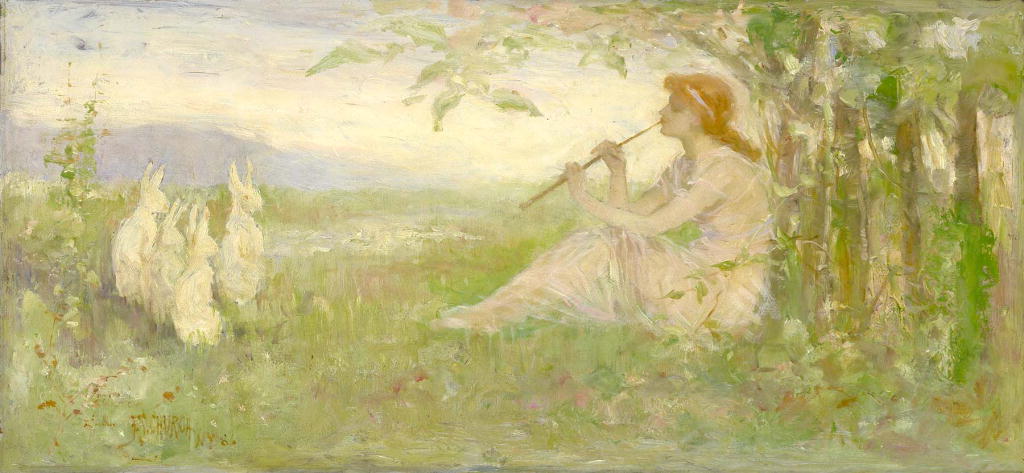
Featured Image: Girl with Rabbits, Frederick Stuart Church





Leave a Reply