
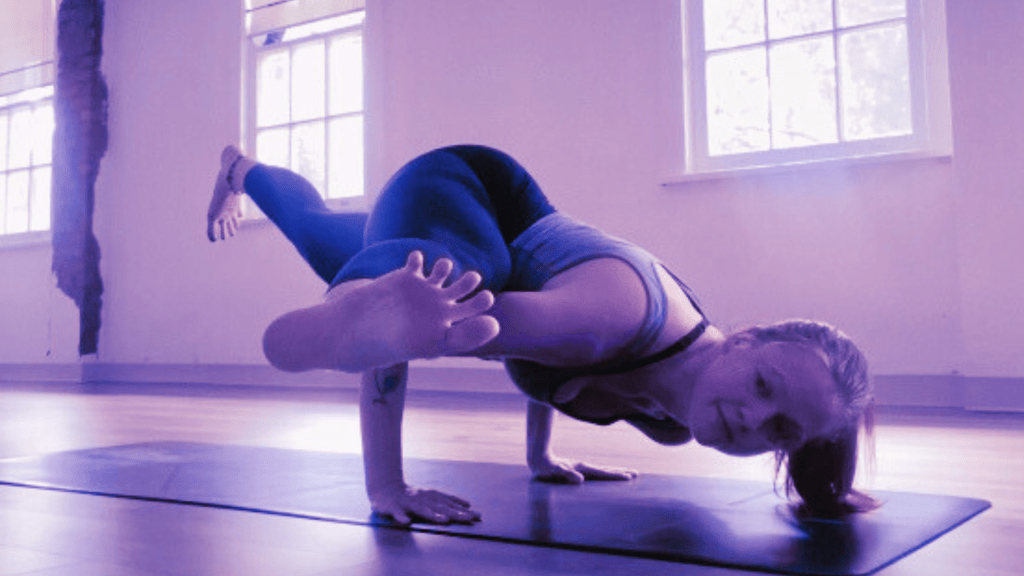
I took a flow class last weekend, one that regularly challenges me both physically and mentally. That morning, however, I just wasn’t feeling it. I was tired from the workweek and needed some energy for teaching my own class later that day. So I hid in the back corner and resolved to really listen to my body (an ongoing challenge).
We were somewhere in the middle of the second sequence when I decided I needed rest more than flow. So I grabbed a tennis ball and block and rolled myself out for the remainder of class. I don’t usually observe people around me, but my low position made it pretty easy to see my surroundings. The person next to me was following the sequence but about a half a breath off beat from others. The person next to her was taking every posture and frequently deepening it in a way that wasn’t being cued… adding binds, standing balance, an arm balance here and there, etc.
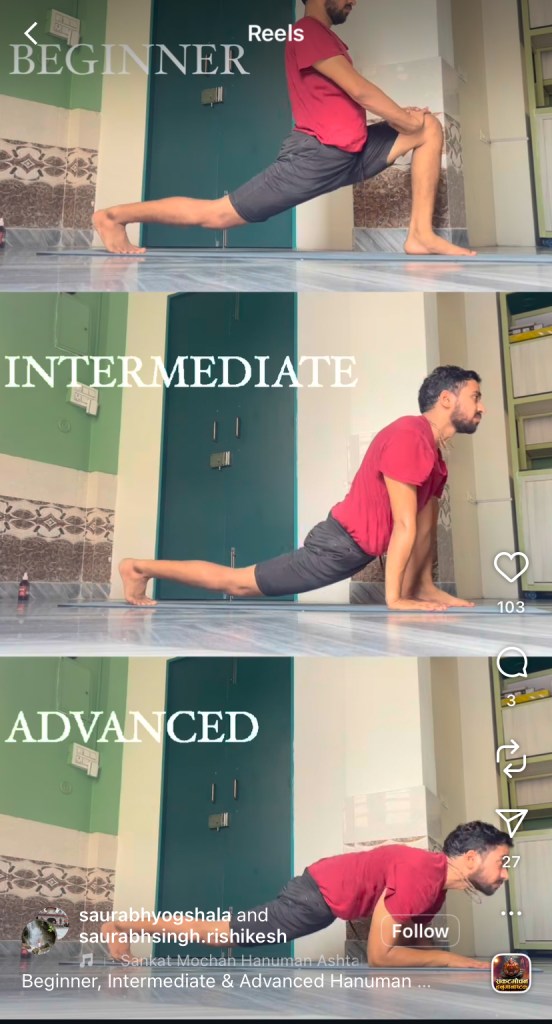
I thought the three of us rather looked like the suggested posts I frequently get on Instagram that demonstrate different variations of the same pose. In such a video, we would be labeled “Beginner,” “Intermediate,” “Advanced,” with me of course being the beginner for taking rest. I laughed to myself as I know all three of us are regular practitioners and were merely following our own vibe for the morning.
And in that, all three of us were practicing “Advanced Yoga.” If you must use such a term, that is.
Don’t get me wrong, I love those Instagram Reels that show multiple variations on a similar pose or intention. I’ve used them to help cue my own classes, ways to modify for a different intention or a way to spice it up. But when I try each, there’s sometimes not one that necessarily feels easier to me. Not if I’m paying close attention.
In fact I often find the “beginner” variations feel more strength-based and the “advanced” variations more mobility-based. For me, the latter is typically easier. It’s quite easy for hypermobile folks to settle into a downward facing dog, for example, with legs straight and heels grounded. I can totally disengage in this pose, just dump into my bones. If I’m truly engaging with the intention of the pose – that is, pressing chest towards thighs and creating a long line between the tailbone and the crown of the head – my heels lift, my elbows bend slightly, my core engages. This is work for my body. The “advanced” version Instagram has shown me is far easier.
Even if the variation labeled “advanced” truly is more challenging, is it appropriate to even call it such? Like while teaching? I find level distinctions are useful in labeling classes (a fundamentals class geared towards absolute beginners is a great example, as is a power class where newbies might get totally lost), but when cuing different variations of a pose, does this help our students or does it discourage them?
I grew up in the ballet world with rigorous conservatory-style training. To be invited to the Advanced class was the biggest honor there was. It was the ultimate goal. To prepare, it was a given that you would take the most advanced version of your teacher’s class, regardless of what your body was telling you. Sports, Pilates, and other movement practices are similar. Advanced means harder, deeper. Advanced means better.
Yoga is different in that it asks us to show up as we are. When we ground ourselves, we tune in to where we are in that single breath. Where we were last week or where we’ll be in 45 minutes is irrelevant; complete presence with reality is the practice. This was the most challenging thing for me when I started. My Greensboro teacher Andrea (a former dancer herself) picked me out almost immediately and taught me that being able to contort myself into the wildest binds imaginable was only scratching the surface of Yoga. Realizing that an “advanced practice” sometimes meant taking rest against the grain of the class was, putting it plainly, a total mindfuck.

This isn’t to say that I don’t teach more challenging progressions of poses, nor do I believe that there really is no physical difference between “beginner” and “advanced” variations. My classes offer lots of opportunities for challenge. I do wish more yoga teachers would simply change the vocabulary. It’s something I’m working on myself as a baby yoga teacher. Instead of “you can advance the pose by x,” I try to use more specific terminology, relevant to the intention. “For more sensation in the hip, you can…” “If you’d like a balance challenge, try…” “To help ground you, maybe try…” And so on and so forth.
It especially irks me when online videos label use of props as “the beginner variation.” Props are hardly for beginners only, they’ve helped me progress more difficult asana many times over! What’s more, labeling props as “for beginners” may dissuade level-conscious practitioners from using them at all, believing they’re some sort of needless crutch instead of a tool for progression. Which may in turn lead to injury.
So Advanced Yoga. I don’t like the term. But if we must use it, let’s reserve it for getting to a place in our practice where we honor our present selves, where we’re tuning in to our bodies’ wisdom. Where taking variations and deepening a posture is a progression of our body’s joy on the mat, not some idea about what the yoga body should look like. And where we know when to ease up and take rest when called to do so.
Turns out that’s a lot harder than an arm balance.





 Five Breaths
Leave a comment